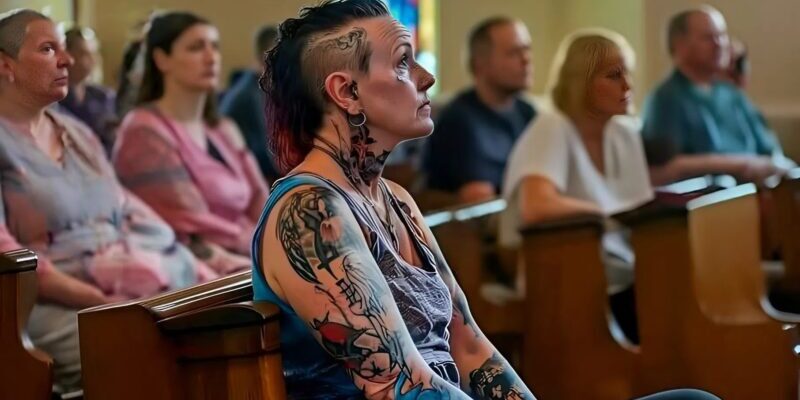
I didn’t understand why someone would wear that to church until I heard her explanation.
I still don’t understand how someone could wear that attire to church 😳🙏. Her remark surprised me.
After the service, I saw her standing near the entrance outside.
I went over to talk to her.
I gently told her that her outfit wasn’t appropriate for a house of worship and suggested that she dress more modestly the next time.
She looked at me like I had crazy eyes.
A Visit to a Church That Made Me Rethink My Opinions
Last Sunday, when I walked into the sanctuary, I had an unforeseen moment of reflection. Standing there was a woman in her forties who had numerous visible body piercings and tattoos.
As a child, I was taught that the church is a sacred space where humility is displayed in everything from our behavior to our clothing. I thought modest and courteous clothing was part of the intended spiritual attitude.
But that day, those long-held beliefs were refuted by this boldly clothed woman.
Do my expectations still stand the test of time? I questioned myself.
Do places of worship really need to have dress codes?
Reassessing Religious Clothes Norms
Seeing her unconventional method made me rethink my preconceptions. After the service, I walked over to her and told her that her dress seemed a bit too garish for a religious setting. In a non-aggressive manner, I advised that she consider wearing a more muted appearance.
She gave a direct and unapologetic response:
“You’re not interested in how I look.”
It was a simple statement, yet it unnerved me greatly. Did I really care what she wore? Or my own outdated customs?
What if the problem is in how we view other people?
At that time, I had to confront my judgments. Maybe I was still clinging to a rigid idea of what one ought to wear to prayer.
In an era where uniqueness is valued, is it reasonable to require everyone to follow a specific dress code?
Do the clothes we wear really reflect the values we hold?
Or should we value the authenticity of the heart more than outward appearance?
Is it still necessary to wear a “proper outfit” to church?
When we were growing up, there were unwritten rules: suits, modest attire, and nothing “too flashy.” These actions promoted harmony and respect.
The line separating “appropriate” from “inappropriate” is blurred these days, though. Tattoos, body piercings, and distinctive apparel have all come to symbolize freedom and uniqueness.
So, should we keep enforcing a dress code that respects God?
For some, yes. For others, it has nothing to do with faith.
Is the church a welcoming or judgmental place?
Isn’t a church’s primary purpose to unite people, welcome them, and promote unity?
We risk missing the crucial things—the person, their life story, and their spiritual growth—when we make snap judgments about someone based solely on how they look.
Every choice of attire and tattoo hides a life, struggles, and religion that may be far more complex than it first seems.
You are dismissing someone’s testimony, their growth, and their value if you only consider their appearance.
Finding Harmony Between Customs and Personal Expression
By following tradition, we can respect our ancestry, faith, and legacy.
Nonetheless, personal expression is another way to be genuine before God.
Instead of doing away with all references, the goal is to find a balance between tradition and openness.
in order to create a setting where everyone may feel valued, whether they wear a suit or jeans, or whether they have tattoos.
Creating a Culture of Respect in Our Communities
Instead of enforcing strict regulations, why not promote an atmosphere of love and respect for one another?
Promote, without judgment or pressure, attire that complements the atmosphere of the establishment.
By encouraging listening and understanding, our churches may actually turn into centers of humanity, faith, and peace.
Putting Our Hearts in Perspective
Christ’s outreach to those who society rejected was a vivid example. He paid more attention to the heart than the appearance.
What if we did the same?
Whether someone is dressed traditionally or simply, what matters is the sincere desire to become closer to God.
By embracing the diversity of paths and expressions, the Church can once again become what it was always meant to be: a place where everyone is welcome.